Table of Contents
ToggleCorner lots and oddly shaped yards present unique challenges, but also unique opportunities. A corner deck can turn an awkward angle into a defined outdoor room, create natural traffic flow, or simply maximize usable square footage without eating into lawn space. Unlike rectangular decks that bulldoze through a landscape, corner designs work with your property’s geometry. They tuck into fence lines, wrap around foundation plantings, or bridge elevation changes. Whether you’re planning a small reading nook or a full entertaining space, these corner deck ideas will help you make the most of every square foot.
Key Takeaways
- Corner deck ideas transform awkward angles and irregular yards into functional outdoor rooms by leveraging existing support from perpendicular walls and fences.
- Multi-level corner decks solve sloped yard challenges with 12–18 inch tier drops, eliminating the need for oversized single platforms while creating naturally defined spaces.
- Built-in corner deck features like storage benches, planters, and privacy screens maximize usable square footage without sacrificing floor space.
- Proper flashing, drainage (minimum 1/8 inch per foot slope), and double-wall step flashing are critical to prevent rot and water pooling in corner deck designs.
- Material selection impacts appearance and durability: composite decking eliminates annual maintenance but requires precise 1/8-inch gapping, while pressure-treated wood is budget-friendly if sealed at cut ends immediately.
- Budget an extra 10–15% for decking materials on corner projects to account for angled cuts, waste, and the perimeter of each level, and ensure all built-ins meet IRC guardrail requirements (36-inch minimum height).
Why Corner Decks Are Perfect for Your Yard
Corner decks solve problems that standard rectangular platforms can’t. They fit into L-shaped house layouts, follow property lines on irregular lots, and turn dead zones, like the narrow strip between a garage and fence, into functional space.
From a structural standpoint, corner decks often require fewer footings than you’d expect. Because they’re anchored along two perpendicular walls (or a wall and a fence), you’re leveraging existing support. That said, always check local building codes, most jurisdictions require permits for decks over 30 inches above grade or larger than 200 square feet. Corner designs that include stairs or cross property setback lines may trigger additional requirements.
Practical benefits: Corner decks create natural zones. The angle itself acts as a divider between, say, a grilling station and a seating area. They also tend to feel more private than front-facing decks because they’re oriented away from the street. If your lot backs into a side yard or alley, a corner deck can frame views while screening less attractive sightlines.
One caution: flashing and drainage get more complex at inside corners. You’ll need step flashing where the deck meets siding on two walls, and you’ll want to pitch the deck away from both walls (minimum 1/8 inch per foot slope) to prevent water pooling. Skipping this step invites rot behind the ledger board.
Multi-Level Corner Deck Designs
If you’re working with a sloped yard, a multi-level corner deck turns a liability into a design feature. Instead of building an 8-foot-tall single-level platform (which feels like a diving board and requires heavy railing), break the elevation change into two or three tiers.
Typical tier drop: 12 to 18 inches between levels. This is enough to define separate spaces without requiring a full set of stairs between them. You can often step down with a single wide tread or a shallow two-step transition.
Structurally, each level needs its own beam-and-joist system. Don’t try to cantilever one level off another, IRC prescribes maximum joist cantilever at one-quarter the joist span (so a 2×8 spanning 10 feet can cantilever 30 inches max). For corner designs, you’ll usually set separate footings for each tier and join the framing with rim joists or blocking.
Material planning: for a two-tier corner deck with approximately 300 square feet total, expect to order 10–15% more decking than the calculated surface area to account for angle cuts, waste, and the perimeter of each level. Nominal 5/4×6 deck boards actually measure 1 inch × 5.5 inches, so adjust your layout accordingly.
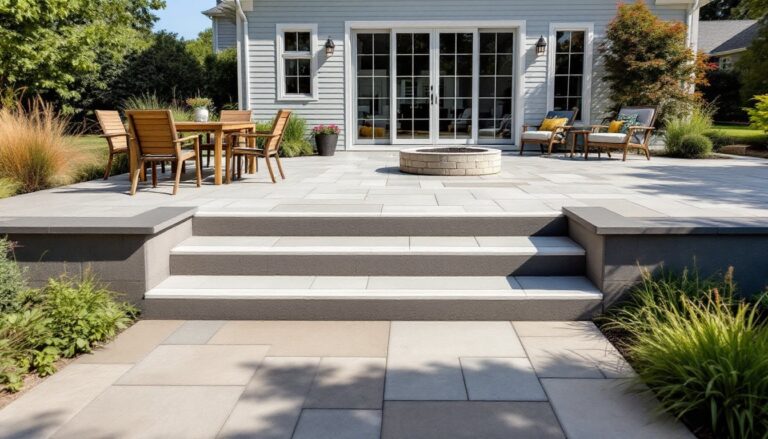
Multi-level designs work especially well when integrated with landscape features like retaining walls or grade transitions. The lower tier can extend into a patio or gravel path, blending hardscape and deck into one continuous flow.
Cozy Corner Deck Seating Arrangements
The geometry of a corner naturally invites seating. Instead of lining chairs along a straight rail, you can nestle furniture into the angle, creating a conversation pit or a sheltered reading nook.
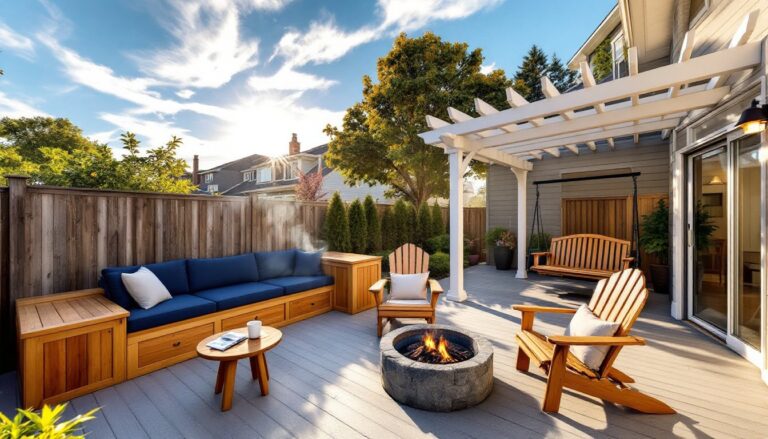
Built-in benches are the most space-efficient option. Frame them with 2×4 or 2×6 lumber on 16-inch centers, then cap with the same decking material you used for the floor. Standard bench height is 17 to 18 inches: seat depth should be 15 to 18 inches. If you’re building an L-shaped bench into the corner, add a 45-degree miter at the joint for a clean look, this is where a miter saw beats a circular saw.
Freestanding furniture works too, but measure carefully. A corner deck with 8-foot legs on each side leaves roughly 50 square feet of usable surface after accounting for railings and traffic paths. That’s enough for a small bistro set or two lounge chairs, but not a full sectional. If you want a sectional, plan for at least 10×10 feet of clear deck.
Privacy and wind: Corners can be breezy. A half-wall or slatted screen on one or both open sides turns a corner deck into a semi-enclosed room. Use 2×2 vertical balusters spaced 3.5 inches apart (to meet code for child safety) or horizontal cable railing for a modern look. For a more traditional feel, lattice panels or vertical boards mounted on a 2×4 frame provide screening without blocking airflow entirely.
Built-In Features to Maximize Your Corner Deck
Built-ins transform a corner deck from a simple platform into an outdoor room. Because corners naturally create alcoves, they’re ideal for integrating storage, seating, and planting areas without sacrificing floor space.
Corner Benches and Storage Solutions
A corner bench with a hinged lid does double duty: seating on top, storage below. Build the frame from 2×4 studs on 16-inch centers, sheath the sides with 1×6 tongue-and-groove boards or the same decking material, and hinge the lid with continuous (piano) hinges for strength.
Size the storage cavity to hold what you actually use, grill covers, cushions, pool toys, garden tools. A 4-foot-long bench holds about 12 cubic feet, enough for a push mower or a bag of charcoal. Vent the cavity with 1-inch holes drilled in the sides to prevent mildew.
For a simpler build, look for plans that rely on pocket hole joinery or basic butt joints reinforced with exterior-grade screws. Avoid finish nails in structural applications, they’ll pull out over time. Use #10 × 3-inch deck screws or 3-inch ring-shank nails driven with a framing nailer.
Planters and Privacy Screens
Built-in planters anchor the corners and soften the hard lines of decking and railing. Frame a planter box with 2×6 or 2×8 lumber, line the inside with EPDM pond liner or heavy-duty landscape fabric, and drill drainage holes in the bottom. Fill with lightweight potting mix, not garden soil, you don’t want to add hundreds of pounds of saturated dirt to your joist system.
Planter size: go bigger than you think. A 12×12-inch box dries out fast. Aim for at least 16×16 inches and 14 inches deep to support perennials or small shrubs.
Privacy screens can frame planters or stand alone. A slatted screen built from 1×4 or 1×6 cedar boards spaced 2 inches apart blocks sightlines while allowing light and air. Mount the screen to 4×4 posts set in the deck frame or bolted to the rim joist. For more detailed woodworking techniques, consider dadoed rails that capture the slat ends, stronger than face-screwing and cleaner-looking.
Safety note: Any built-in that raises the effective railing height or reduces the 4-inch sphere rule (no openings large enough for a 4-inch ball to pass through) must still meet IRC guardrail requirements. If your bench or planter sits against a railing, the total height from the deck surface to the top of the railing must be at least 36 inches.
Material and Color Choices for Corner Decks
Material choice affects appearance, maintenance, and structural span. For corner decks, especially those with complex angles, consistency in board length and straightness matters.
Pressure-treated pine is the budget standard. Nominal 2×6 decking (actual 1.5 × 5.5 inches) costs $2 to $4 per linear foot depending on grade and region. Use #2 or better for decking: #1 grade is straighter but pricier. Let PT lumber acclimate outdoors for two to four weeks before installation to minimize cupping and warping. Seal cut ends with a wood preservative immediately.
Cedar and redwood resist rot naturally and take stain beautifully, but they’re softer, expect surface dents from dropped tools or furniture. They also cost $5 to $10 per linear foot. If you’re staining or sealing, reapply every two to three years.
Composite decking (brands like Trex, TimberTech, Azek) eliminates annual staining and reduces splintering. It costs $8 to $12 per linear foot and requires specific fastening systems (often hidden clips). Composite expands and contracts more than wood, so follow the manufacturer’s gapping specs, usually 1/8 inch on the ends, 1/16 inch on the sides. On corner decks with angled cuts, this gets fussy. A 12-inch miter saw with a fine-tooth blade (60+ teeth) gives the cleanest cuts.
Color strategy: Light grays and tans reflect heat and show less dirt. Dark browns and charcoals highlight scratches and can get uncomfortably hot in direct sun (surface temps above 140°F in summer). If you’re mixing materials, say, composite decking with wood railings, sample them side-by-side first. Colors that look complementary in a catalog can clash outdoors.
Fasteners: Always use hot-dipped galvanized or stainless steel screws and hardware. The extra cost ($10 to $20 for a pound of screws) beats replacing rusted-out framing in five years. For composite, use the fastener system the manufacturer recommends to preserve your warranty.
Corner decks amplify minor material defects. A warped board that’s tolerable on a straight run becomes obvious when mitered at 45 degrees. Budget an extra 10% for culling and cutting around knots or splits.